By Ooi Kee Beng
In 1787, a few months after Francis Light settled in Penang on behalf of the East India Company, Captain Robert Kyd of the Bengal Engineers arrived to study the island’s harbour capabilities, the soil and the flora it supported, as well as the possible advantages the British could gain from the settlement in general. Kyd was a passionate horticulturalist and would become well known in India as General Kyd. There, he is best remembered as the man behind the famous Botanic Garden in Calcutta, incidentally founded in July that same year. The garden was renamed the Indian Botanic Garden in 1950.
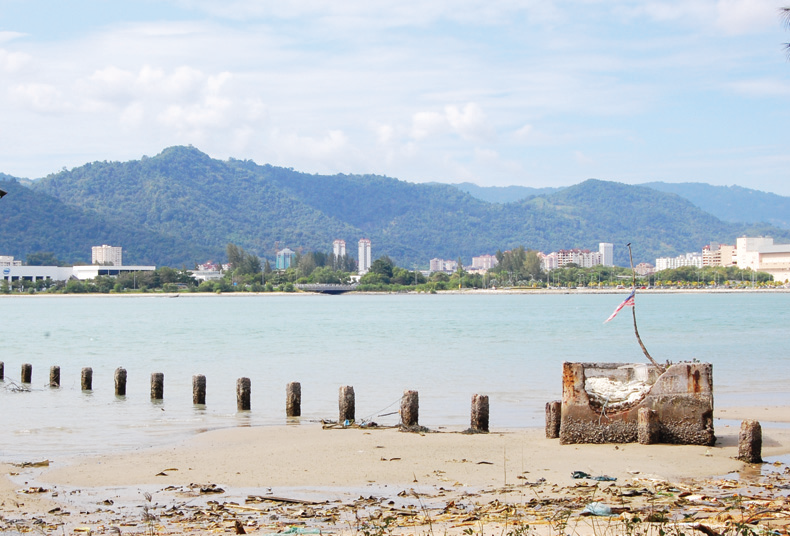
In his 1787 survey of Penang, Captain Kyd included a long paragraph about the island of “Jerajah”, which must surely be the earliest description of Penang Island’s little twin.
__________
“The island of Jerajah is about two miles in length and one in breadth, it is very high and steep and thickly covered with wood in the same manner as Pinang, and upon this island alone are a very great number of Poon trees fit for masts for the largest ships. The water is very deep close the shore of the island but on the Pinang side there is a mud bank that runs from the shore about 300 yards and is dry at low water. From this mud bank it immediately deepens into five fathoms and continues deepening gradually over to Jerajah where there is for the most part six fathoms. There are a great many rills of excellent water on the island, but one emptying itself at a fine Sandy Beach which would supply a large fleet and with a very small expence and trouble might be conveyed by an aqueduct to fill casks in boats. As the hills rise very steep from the water’s edge there is no getting along the shores of the island, and there is but very little level space of any kind on it, yet there are three small Bays lying close to one another where there is room enough for a marine yard, for Store Houses, and every necessary building that a large fleet could be in want of in refitting, and in one of these recesses there might with little trouble be a wharf constructed where large ships could heave down to careen, and come alongside of to take out their guns, masts, &c. There is also sufficient room on some of the projecting eminences for building Hospitals or Bungalows for the Officers of such ships as might be refitting.
“The whole of the ground opposite to Jerajah is overflowed at spring tides for near a mile and is thickly covered with mangroves and other aquatic trees. It would however cost but a little to embank a mile square of it for garden ground, for live stock and for a place for the seamen of the fleet to take exercise and recreation, and experience has shewn that a situation of this kind upon the Coast is not unhealthy although so noxious in many other climates, for the Fort Point has close to it an overflow of this kind and no place was ever more healthy, indeed Queda and most of the towns on the sea coast of Malacca are overflown by the spring tides, which the Malays are not industrious enough to exclude by an embankment, but build their houses on stakes about six feet from the ground, and it is allowed that generally speaking the whole Peninsula of Malacca is remarkably healthy. There is a passage between Jerajah and Pinang to the southward where there is water enough for a ship of the line, but so narrow and intricate as not to admit of its being commonly used, but especially to enter the harbour, which on many accounts must at all times be very difficult, but principally from a certainty of having variable baffling winds off the high land of the island in a long and very narrow passage where a ship has not room to work and from being obliged to enter with a falling tide the egg setting to the northward. But a person well acquainted with the passage and by laying buoys or boats on the banks may certainly take a ship of any size out with great safety and as it must be done with the flood there is the advantage of a rising tide. The bottom in both the outer and inner harbour is a soft blue clay, nor is there in any part of them either rocks, stone, coral or any thing that can hurt a cable, but vessels should immediately moor on coming into the outer harbour, for as the tides are very irregular in their setting it is very difficult when riding at a single anchor to keep it clear, in which case a ship is liable to drive in short squalls that frequently come off the continent; neither do I think the ground is sufficiently stiff to hold without the precaution of mooring.”
— The Journal of the Indian Archipelago and Eastern Asia, Vol. IV, pp. 640-641. Edited by J.R. Logan. Singapore. 1850. (Reprinted in 1970 by Kraus-Thomson Organization Ltd of Nendeln/Liechtenstein).
__________
Note: “Poon trees” are any of several East Indian trees of the genus Calophyllum inophyllum which yield a light, hard wood used for masts, spars, etc. The term originates from the Tamil punnai and pinnai and the Malayalam punna. (http://dictionary.reference.com).
It would seem that Kyd’s optimistic belief in the “not unhealthy” mangrove areas is contradicted by the poor health and premature deaths of various early English settlers, including Francis Light himself.