People Economics — January 31, 2012

Continuing a 125-year-old internationalisation strategy


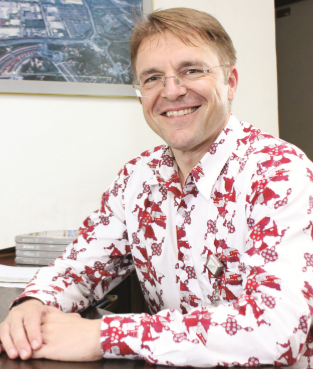
For January 2012, our Faces of Industrial Penang series continues with Michael Kloss of Robert Bosch Malaysia. Having served in Bosch for nearly two decades, he is a veteran of the expatriate talent circle with global placements spanning Europe, Mexico and Asia. Kloss offers us a range of insights on key approaches and winning formulas from within the boardroom and operations framework of a distinguished MNC. He also seizes the moment to share with us his enthusiasm and vision for Bosch’s latest corporate venture, Solar Energy.

By Poh Heem Heem

How long have you been at Bosch in Penang?
I have been here since August 2009 as the commercial managing director of Robert Bosch Malaysia Sdn Bhd. I joined Robert Bosch in 1993, and have held various positions around the globe and in different business fields within the automotive and consumer goods sector.

Was this assignment by choice or by company posting?
Bosch celebrates its 125th anniversary this year and has more than 350 subsidiaries and regional companies in over 60 countries as part of its development, manufacturing and sales network. In 2010, approximately 77% of our total sales were generated outside Germany. Our founder, Robert Bosch saw internationalisation as a strategy and opportunity for growth; hence our globalised operating structure is almost as old as the company itself. International assignments are very common to the organisation, but a key success factor for us is the alignment of the competencies and needs of Bosch associates with the operating structure and the staffing needs of its various worldwide establishments. This applies to my assignment. I chose to serve Bosch in Malaysia and was chosen to serve the Bosch Car Multimedia plant in Penang.

How does Penang rate as a home away from home, and how easy has it been for the family to adapt and fit in?
We are experienced expatriates who have lived for more than four years in Mexico and more than four years in the Netherlands. However, Penang is our first experience living in Asia. Penang is very diverse and home to different races and cultures. It offers a high standard of living. We went through some tough weeks of adaptation in the beginning, but eventually, the relocation process became easy for us.

What was the toughest challenge when adapting to life in Penang?
The toughest challenges were those my family had to overcome; my spouse and especially my two kids were leaving family and friends behind and making new friends in an unknown environment without speaking the language. This was tough on them, but they mastered it well!

Did the reality of working in Bosch Penang match your expectations?
My job description and tasks were well defined from the beginning. The company had to undergo a process of restructuring in order to achieve a large growth projection anticipated in the next few years. Part of my responsibilities here were to guide and manoeuvre the organisation through this process of restructuring. Processes and structures had to be adjusted and the change management led to some harsh cuts in our organisation. However, we had a clear forwardlooking strategy and we have already recorded a strong positive turnaround. Profitable growth and restructuring will continue and by 2013 we will have changed completely.

How many people does Bosch employ?
Bosch worldwide employs around 300,000 associates, of which Penang hosts some 2,500 in two different businesses, Car Multimedia and Power Tools. In addition to that we also have a joint-venture company with the German company ZF Friedrichshafen here in Penang – “ZF Steering”; as well as regional headquarters in Kuala Lumpur.

How will the numbers change with the setup of the new solar plant?

Bosch Solar Energy will require an additional 2,000 associates, once fully operational and staffed.

At a time where the labour market in Penang is very tight, with high demand within the pool of engineers, why did Bosch choose Penang as the location for its solar plant?

Since 1972, Bosch has been successfully conducting business out of Penang and the decision to bring our Solar Energy plant here reflects our conviction that Penang is the location capable of delivery. Bosch explored and analysed 45 sites in 23 countries, and in Malaysia alone, we explored 10 sites on various quantitative and qualitative factors. The important decision drivers are the availability of a strong supply chain, the excellent electrical & electronics (E&E) clustering, good infrastructure support and the strategic location of Batu Kawan, supported by Penang, a liveable town with a probusiness approach. The critical competitive advantage to us is Penang as the “Silicon Valley of the East” with its pool of experienced E&E engineers. Of course I agree it is not easy to find and compete for good engineers, but Bosch is well prepared to do what it takes to inspire, motivate and retain talent in Penang.

What is your leadership style?
If you google “Leadership” you get close to 500 million hits. This is an indication of the many different opinions there are on leadership and what an effective leadership style should look like. From my professional and personal experience, there is no specific leadership style which works for me. I learned that I had to adjust my style to specific organisation situations, the maturity of its staff, its management competency levels, the business situation, cultural aspects and much more. Depending on the scenario, I am sometimes a “do as I say” leader, sometimes I sell, and in other cases I apply a participating or delegating style. Important to me is the development of a culture of openness and trust in the organisation which includes straightforward communication and not the “beating around the bush mentality”. This took some time for my colleagues to adjust to.

How do you ensure knowledge transfer from your experience towards your management team and your people?
Knowledge and knowledge transfer within Robert Bosch have very high priority. Bosch has implemented a leadership tool to effectively manage its competencies. Within the organisation we have defined roles with certain mandatory competencies which the role holder needs to have or to develop. This applies to the management, too. In fulfilling staffing and assignment roles, we compare the needs of the roles with the characteristics of the associate. If there are gaps, and normally there are, we close them via defined actions. This annual process is mandatory for all white collar staff, and we are in the process of rolling this out to all blue collar staff too. To prepare for succession, we have a development plan as well. This is a yearly rolling plan for a horizon of three to five years in which we prepare associates to enable them to eventually take over a certain targeted position. All managerial staff are also subjected to a Bosch worldwide standardised management development programme.

Can you list a major change you implemented at Bosch during your tenure and briefly describe its impact on the organisation and its people?
To prepare ourselves for significant growth within the next years and to further transform the company, my technical colleague and I kicked off a Change Management Process using the John Kotter concept from Harvard Business School. The core of this process is to activate resources within the entire organisation as we truly believe that we need the support and commitment of each and every associate, being managerial staff or operational specialist. This brought a lot of transparency and empowerment into the company. I am also working to convince our associates to always think “out of the box”. We have a lot of creative talent here who unfortunately are much too focused on their day-to-day operational work. We have seen some promising changes.

Are you satisfied with what you have achieved to date in Bosch Penang?
We are definitely on the right track, and we still can do much better.

What changes would you like to see in Penang 10 years from now?
Penang already offers a lot. However, I see potential for further growth within the business sector of renewable energy. Penang must take advantage of its geographical location on the Sunbelt. It has what it takes to support and promote investment into Solar Power through clean technology solar plants, and eventually play a critical role in the reduction of carbon dioxide-emitting energy resources for homes and industries alike. Second is the intelligent management of the increasing traffic flow and the reduction of carbon dioxide emissions caused by traffic jams. Singapore, together with Bosch, currently studies a concept using electricity-powered cars and Penang should do the same. This would not only generate new business opportunities for Penang, but in tandem help to sustain the high living standards of this Pearl of the Orient.


Why compete when you can collaborate?
Secret to success: Doing your best at what you do best
Managing Malaysia's first EMC lab
Faces of industrial Penang: Hamdan - Doer and Dreamer

Switch to our mobile site